
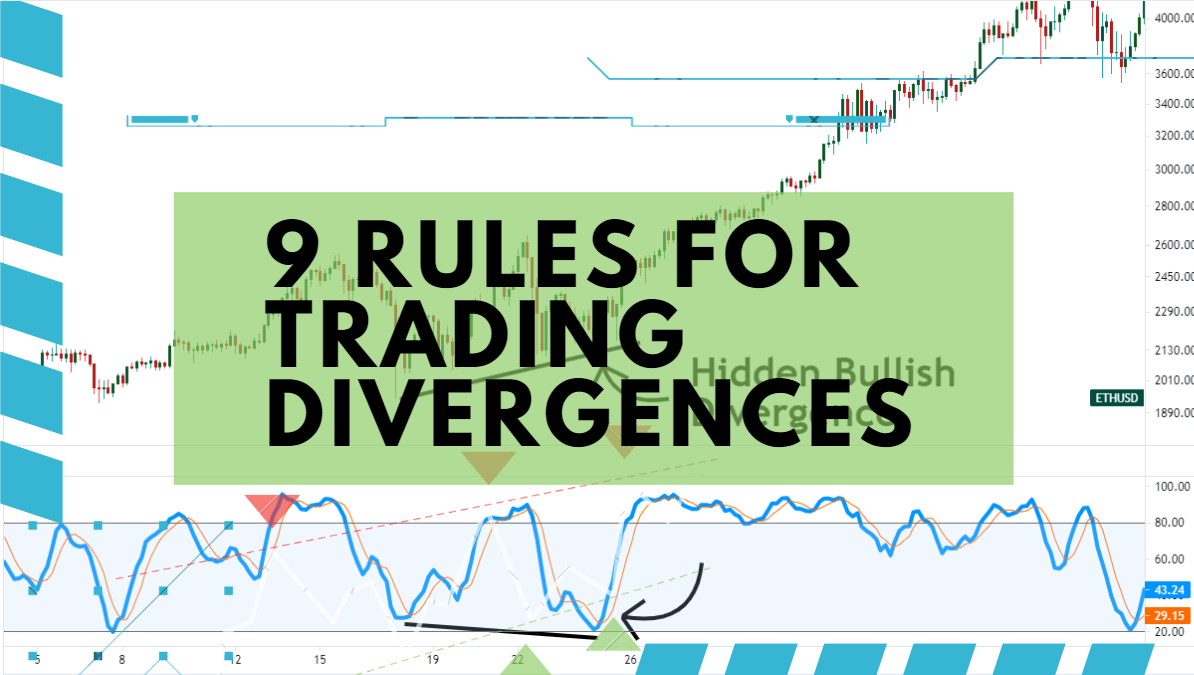
Divergences are used by traders in an attempt to assess if a trend is getting weaker, which may lead to a trend reversal or continuance.
Before you go out and start hunting for probable divergences, here are nine amazing trading divergences guidelines.
Learn them, memorize them , and use them to help you make better trading decisions.
1. Make sure your glasses are clean
In order for a divergence to exist, the price must have either formed one of the following:
- Higher high than the previous high
- Lower low than the previous low
- Double Top
- Double Bottom
If ONE of these four price possibilities has occurred, don’t even bother looking at an indicator.
If not, you ain’t trading a divergence, buddy.
You’re just making things up. Go visit your optometrist right away and get some new glasses.


2. Draw lines on successive tops and bottoms
Now that you’ve got some action (recent price action), have a look at it. Keep in mind that you will only witness one of four things: a higher high, a flat high, a lower low, or a flat low.
Draw a line from that high or low back to the preceding high or low. It MUST be on consecutive significant tops/bottoms.
If you notice any minor bumps or dips between the two major highs and lows, do what you do when your significant other yells at you: ignore it.
3. Connect TOPS and BOTTOMS Only
Once you notice two swing highs are established, you link the TOPS.
If you make two lows, you link the BOTTOMS.


4. Keep Your Eyes on the Price
So you’ve drawn a trend line connecting two tops or two bottoms. Examine your favorite technical indicator in relation to price action.
Remember that you are comparing the TOPS or BOTTOMS of the indicator.
Some indicators such as MACD or Stochastic have many lines all up on each other like teenagers with raging hormones. Don’t be concerned about what these kids are up to.
5. Be Consistent with Your Swing Highs and Lows
If you create a line linking two highs on the price chart, you must also draw a line connecting two highs on the indicator. The same goes for lows.
You MUST draw a line connecting two lows on the indicator if you draw a line connecting two lows on the price. They must match!
6. Keep Price and Indicator Swings in Vertical Alignment
The highs and lows you identify on the indicator MUST VERTICALLY line up with the price highs and lows.
It’s like deciding what to wear to a club; you have to be fly and matchin’ yo!
Maintain vertical alignment with the swing highs and lows of the PRICE and the swing highs and lows of the INIDCATOR.
7. Watch the Slopes
Divergence only happens if the SLOPE of the line connecting the indicator tops/bottoms DIFFERS from the SLOPE of the line joining price tops/bottoms.
The slope must be either ascending (rising) Descending (falling) (falling) Flat (flat) (flat).
8. If the ship has sailed, catch the next one.
If you see divergence but the price has already reversed and moved in one direction for some time, consider the divergence played out.
This time, you missed the boat. All you have to do now is wait for another swing high/low to emerge before restarting your divergence search.
9. Take a Step Back
Divergence signals are more precise on longer time scales. You get fewer misleading signals.
This implies fewer trades, but if you build your trade correctly, the profit potential is enormous.
The term “electronic commerce” refers to the sale of electronic goods. We recommend just looking for divergences on 1-hour or longer charts.
Other traders utilize 15-minute or even faster charts. In some time frames, there’s just too much noise for our liking so we just stay away.
Next Lesson: Divergence are NOT a Trade Signal