
To put it simply, volatility is the amount a market might potentially fluctuate in a particular period of time.
Knowing how much a currency pair tends to change might help you set the proper stop loss levels and prevent being forced out of a trade due to random price variations.
For example, if you are in a swing trade and know that the EUR/USD has moved roughly 100 pips each day over the last month, setting your stop to 20 pips will most likely have you stopped out too early on a little intraday move against you.
Knowing the average volatility allows you to set your stops in order to give your trade some breathing room and a chance to succeed.
Method #1 : Bollinger Bands
As we discussed in a previous session, one method for measuring volatility is to use Bollinger Bands.
Bollinger Bands can help you determine how volatile the market is right now.
This is especially handy if you are practicing range trading. Set your stop just beyond the bands.
If price reaches this level, it indicates that volatility is increasing and that a breakout is possible.

Method #2: Average True Range (ATR)
The Average True Range (ATR) indicator can also be used to calculate average volatility.
This is a standard indication accessible on most charting platforms, and it’s very simple to use.
All the ATR asks is that you enter the “period” or number of bars, candlesticks, or time to calculate the average range.
For example, if you are viewing a daily chart and enter “20” into the settings, the ATR indicator will magically generate the pair’s average range for the last 20 days.
Alternatively, if you are looking at an hourly chart and enter 50 into the settings, the ATR indicator will display the average movement of the last 50 hours. Pretty good, right?
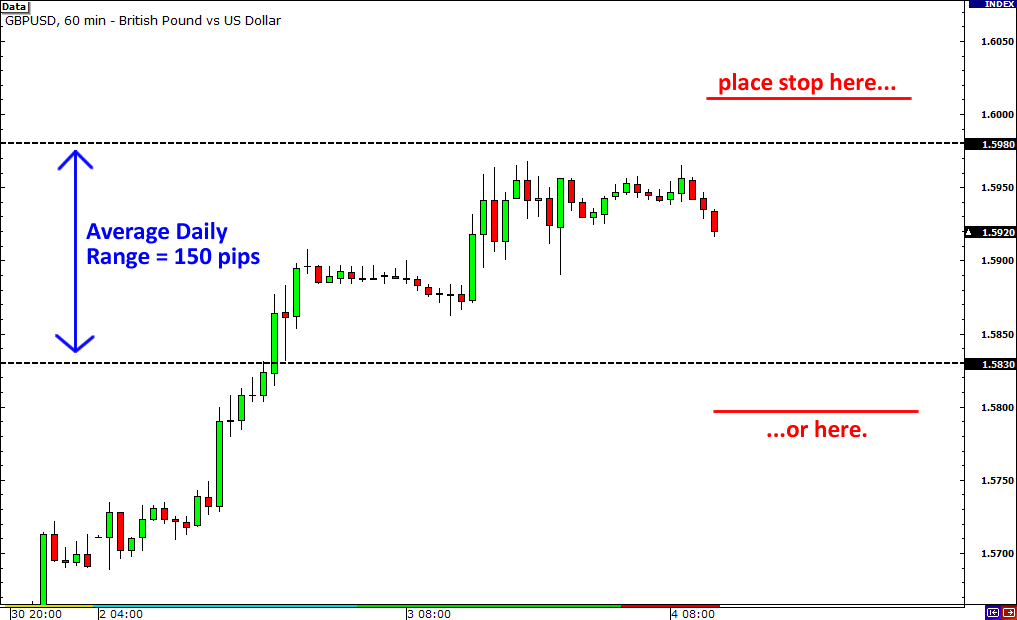
This method can be used as a stand-alone stop or in conjunction with other stop loss approaches.
The goal is to allow your transaction enough breathing room for minor variations before it heads your way… and hopefully it does.
Based on a Time Limit
Time stops are stops that you establish in a trade depending on a specific time.
It could be a defined time (open limit time of hours, days, weeks, etc. ), only trading during specific trading sessions, the market’s open or active hours, or anything else.
Assume you’re an intraday trader who just placed a long bet on EUR/CHF and it hasn’t gone anywhere.
We’re in snoozeville territory here!

Why keep your money locked up in this trade when you can use it to take advantage of this one.

More pips, more movement! Yes, sir!
Because of your predetermined restrictions and your dislike of holding trades overnight, you’ve chosen to close the position at 4:00 p.m., when you’re usually done for the day, and head to your bi-weekly poker tournament.
Perhaps you are a swing trader who decided to close your positions on Friday in order to minimize gaps and weekend event risk.
Furthermore, having some margin locked up in a dead trade may cost you an opportunity in another outstanding trading setting elsewhere.
Set a time limit and remove the dead weight so that money can perform its job.