
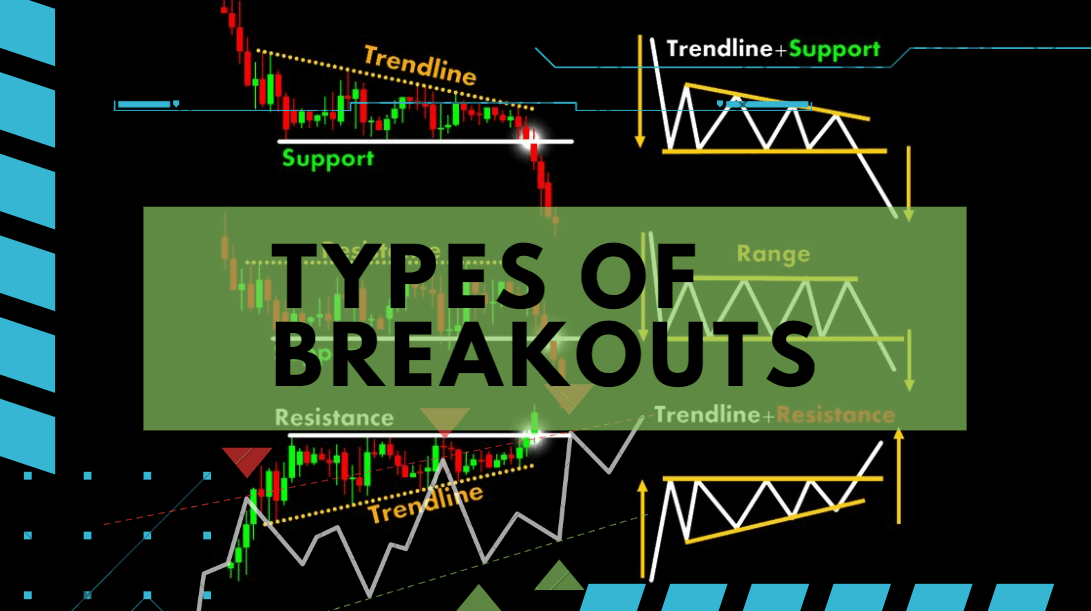
Understanding that there are primarily two sorts of breakouts when trading forex is crucial.
- Continuation Breakouts
- Reversal Breakouts
Making sense of what is truly happening in the market’s overall large picture will be made easier if you are aware of the type of breakout you are seeing.
Because they signal a shift in the supply and demand of the currency pair you are trading, breakouts are important.
This shift in attitude may result in significant movements that offer fantastic chances for you to scoop up some pip.
Continuation Breakouts
The market will frequently pause when there has been a significant move in one direction.
When buyers and sellers hesitate to decide what to do next, this happens.
You will consequently witness a phase of range-bound movement known as consolidation.

A continuation breakout happens when traders decide that sticking with the initial trend was the appropriate move and keep driving the price in that direction. Just consider it a “repeat” of the initial trend.

Reversal Breakouts
Similar to continuation breakouts, reversal breakouts begin with a halt or consolidation that follows a prolonged trend.

Only after this consolidation do forex traders decide that the trend has run its course and push the price in the other, or “reverse,” direction.
You then experience a “reversal breakout,” as a result.

False Breakouts
We are aware that you are eager to start trading breakouts at this point, but you must also exercise caution.
The market can deceive you and cause false breakouts, just way Lionel Messi can fool defenders.
False breakouts happen when the price crosses over an important level (such as a trend line, triangle, support, or resistance) without accelerating further in that direction.
Instead, you might have observed a brief surge in price followed by a return to the trading range.

Waiting until the price retraces back to the breakout level and then watching to see if it rebounds back to make a new high or low is a smart approach to enter on a breakout (depending on which direction you are trading).

Not taking the first breakout you see is another technique to avoid fakeouts.
You increase your chances of executing a successful deal by waiting to see if the price will keep moving in the way you want it to.
The disadvantage of this is that you might pass on some deals where the price moves swiftly and unhesitatingly.
Next Lesson: How to Trade Breakouts Using Trend Lines, Channels and Triangles