

What exactly does “Free Margin” mean? Margin can be categorized as “utilized” or “free.”
In a previous article, we explored Used Margin, which is simply the sum of all open positions’ Required Margin.
The difference between equity and used margin is the free margin. The equity in a trader’s account that is not tied up in margin for current open positions is referred to as free margin. Free margin is sometimes known as “usable margin” since it is margin that you can “use.”
There are two ways to think about free margin:
- 1. The amount available to open NEW positions.
- 2. The amount that EXISTING positions can move against you before you receive a Margin Call or Stop Out.
How to Calculate Free Margin?
Free Margin = Equity - Used Margin
If you have open positions that are now profitable, your Equity will rise, which implies you will have greater Free Margin.
Floating profits boost Equity, which boosts Free Margin.
If you have open trades that are losing money, your equity will drop, which means you will have less free margin.
Floating losses reduce Equity, which in turn reduces Free Margin.
Example: No Open Positions
Let’s start with a simple example.
You make a $1,000 deposit into your trading account.
What is your Free Margin if you don’t have any open positions?
Step 1: Calculate Equity
Calculating the Equity is simple if you don’t have any open positions. The Equity is the SAME as the Balance.
You have no floating earnings or losses because you have no open positions.
Equity = Account Balance + Floating Profits (or Losses)
$1,000 = $1,000 + $0

Step 2: Calculate Free Margin
If you do not have any open trades, the Free Margin equals the Equity. There is no margin being “utilized” because you do not have any open positions.
This means that your Free Margin and Balance will be the same.

Example: Open a Long USD/JPY Position
Let’s make things a little more complicated by making a trade!
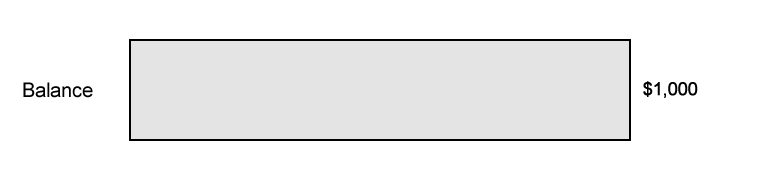
Assume you have a $1,000 account balance.
Step 1: Calculate Required Margin
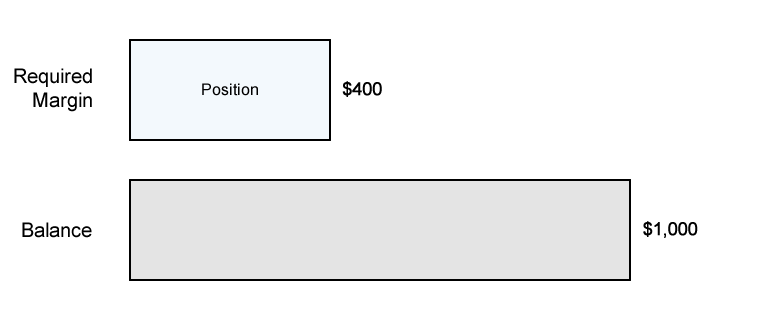
You wish to go long USD/JPY and open a position of 1 mini lot (10,000 units). The required margin is 4%.
How much margin will you need to open the position (Required Margin)?
Because the USD is the foundation currency. This tiny lot is $10,000, hence the position’s Notional Value is $10,000.
Required Margin = Notional Value x Margin Requirement
$400 = $10,000 x .04
Assuming your trading account is in USD, the Required Margin will be $400 because the Margin Requirement is 4%.
Step 2: Calculate Used Margin
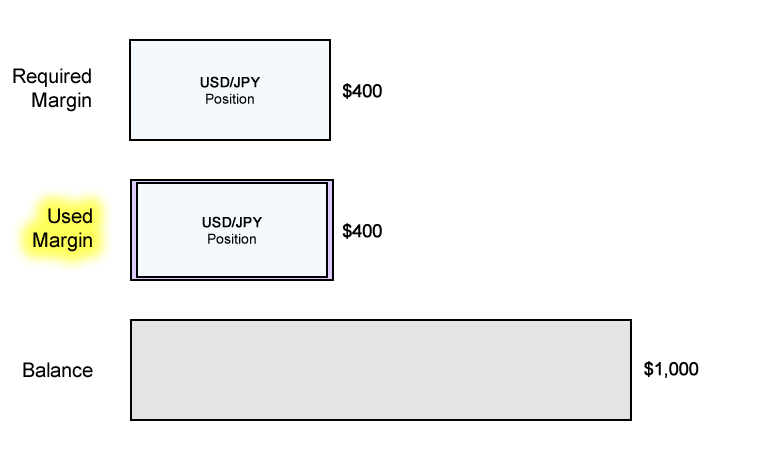
There are no other trades open than the one we just entered.
Because we only have ONE position open, the Used Margin will be the same as the Required Margin.
Step 3: Calculate Equity
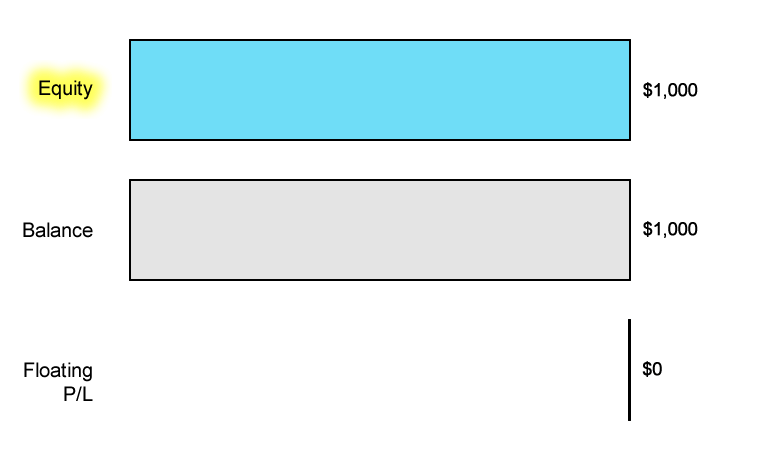
Let’s assume that the price has moved slightly in your favor and your position is now trading at breakeven.
This means that your floating P/L is $0.
Let’s calculate your Equity:
Equity = Account Balance + Floating Profits (or Losses)
$1,000 = $1,000 + $0
The Equity in your account is now $1,000
Step 4: Calculate Free Margin
Now that we know the Equity, we can now calculate the Free Margin:
Free Margin = Equity - Used Margin
$600 = $1,000 - $400
The Free Margin is $600

As you can see, another way to think about Equity is the total of your Used and Free margins.
Equity = Used Margin + Free Margin
Next Lesson: What is Margin Level?